The standard Kyoto sightseeing route is probably Kiyomizu-dera / Kinkaku-ji / Ginkaku-ji / Sanjusangen-do. We’d already done our cherry blossom viewing in the morning, so we figured we’d do some sightseeing and headed for Kinkaku-ji. Honestly, Kinkaku-ji doesn’t have all that much to see, but if you want to say with confidence later that you’ve been to Kyoto, you’ve got to at least stop by Kinkaku-ji and Kiyomizu-dera like everyone else does.
Kinkaku-ji admission ticket

Maybe because it’s a world-famous attraction, the ticket is unusually a paper talisman. Stick it in a corner of your house and your household will probably be at peace. But wait, weren’t talismans a shrine thing…
Kinkaku-ji

You see it straight ahead as soon as you walk in. There were so many people it wasn’t easy to take it all in, but anyway, it’s a gorgeous view. The temple’s real name is Rokuon-ji, and it got the nickname Kinkaku-ji because of this golden pavilion (the Shariden).
Up close it looks like this..

It’s covered in gold leaf, and it shines even more than I remember from my visit a long time ago. Looks like they restored the exterior.. I was impressed even by this much, but my travel companions this time made a huge fuss: “It’s the Golden Pavilion and they only put gold leaf on it?”, “At least one pillar should be solid gold!”, “They should rename it the Gold-Plated Temple!” and so on. With gold prices the way they are these days, we should be grateful for this much..
To be honest there isn’t much to see at Kinkaku-ji, so you get round it quickly. Wondering where to go next, we set off for Ryoan-ji, just nearby.
Ryoan-ji’s rock garden..

They say it expresses the deep meaning of Zen, but that’s not something a photo can convey. Go and see for yourself. This rock garden is so famous that there are lots of knockoffs. When you go to a fairly well-known Japanese restaurant there’s often a small gravel garden, and I think it’s safe to say that’s this temple’s influence…
Unusual pine trees

Whereas Kinkaku-ji has little to see apart from the pavilion itself, Ryoan-ji’s grounds are really well kept. How on earth did they prune these pines so beautifully.. It felt like looking at aesthetics taken to the extreme. Some people might call it damaging nature, though.
Cherry blossoms, close up

It looked like a shower of petals was about to come down. The cherry blossoms in central Kyoto were already past their peak, but the ones at Ryoan-ji last longer. Probably because they’re so well tended.
Cherry blossoms at Ryoan-ji

These aren’t the flashy, bursting-with-spring-life full-bloom kind of cherry blossoms, but a very calm, elegant style. The gardeners prune each branch by hand. You could call it artificial, but personally I like this better.
Simple, beautiful blossoms

There are many different kinds of cherry trees too. The amount of care that goes into this must be enormous.
Close-up

For the cherry blossoms alone, the Philosopher’s Path might be much better, but in terms of beauty I’d give it to Ryoan-ji.
Falling petals

Maybe because they’re so well pruned, the petals don’t seem to fall in clumps.
Unreal beauty..
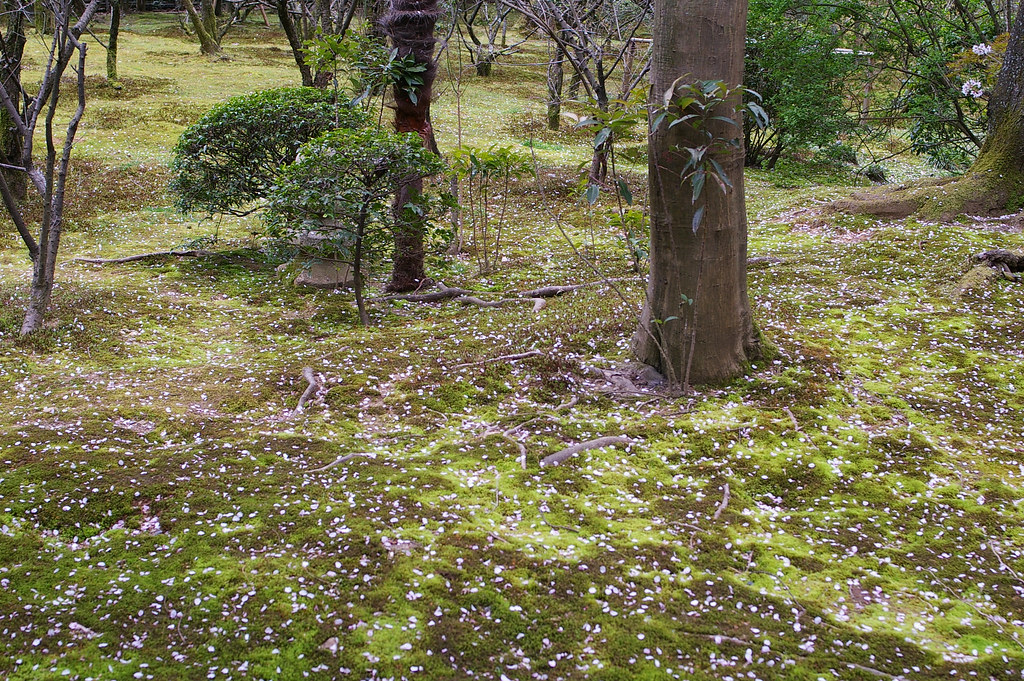
I’ve seen my share of cherry blossoms, but this day was probably the first time I saw blossoms that captured my heart without being showy.
The pond

Compared to poorly kept Kinkaku-ji, it’s a world of difference. The feeling that I was glad I came kept growing on me.
Close-up of the blossoms

I don’t usually take close-ups, but they were so pretty I gave it a go.
After finishing up at Ryoan-ji, we wondered where to go next, and decided to head back to the Philosopher’s Path to compare Kyoto’s cherry blossoms.
Philosopher’s Path

The weather was worse than in the morning so I didn’t get any decent photos, but I’d taken plenty in the morning, so I didn’t mind much.