This post was written in 2007. Shop details and prices may have changed since then.
After striking out at Nakamura, I headed straight to Yamashita nearby. This is another famous shop where the line never stops. I suspect it’s probably the best-known name in the whole Sanuki area. You can even find their udon for sale all over town.
This is what the line looks like.
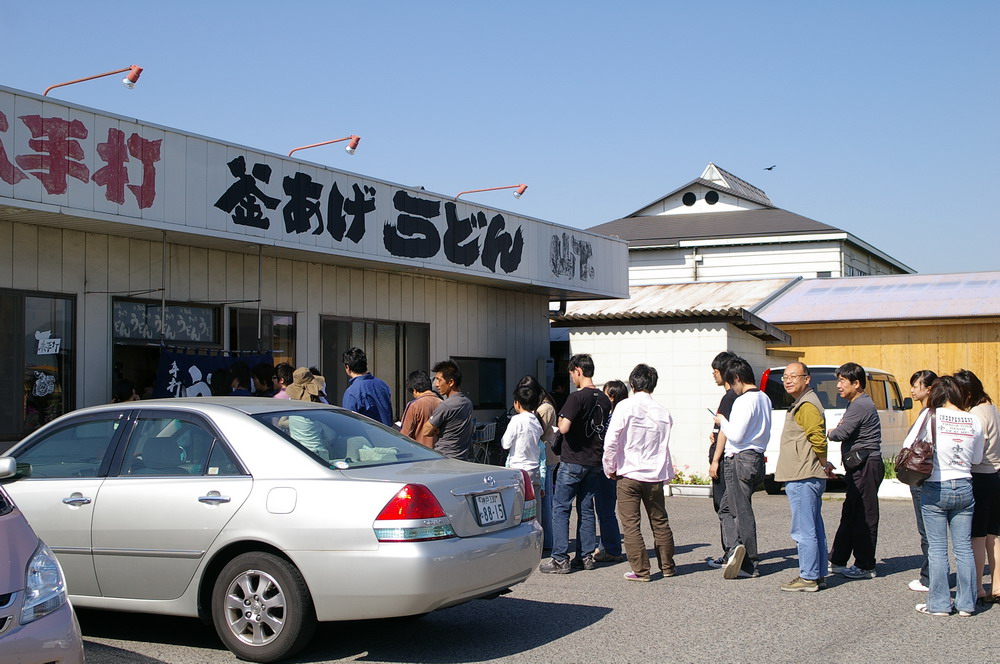
There used to be a second line that let you eat outside, but partway through they just shut it. I was shocked at how unfriendly that was.
Here’s the view outside.

Only a chosen few get to eat their udon while gazing out at this peaceful Sanuki countryside.
The feel inside the shop.

What I ordered: a large shrimp tempura bukkake udon. I remember it being 630 yen.

Classic chewy, springy Sanuki udon noodles. And of course the tempura is well done too.
The dashi is in here. Big, huh ^_^;

Ginger is self-serve.

The finished bowl.

It was worth the long wait, but with so many customers the noodles were a little inconsistent in how well they were boiled. Even so, I’d say it was a success for my first taste of Sanuki udon.
The place I was staying turned out to be near Takamatsu’s nightlife district -_-;; and maybe because of that, there were a few udon shops nearby open until late at night. You can’t just go to bed because it’s nighttime, right? Not when you’ve come all the way to Sanuki… So I wandered around town.
Konpira Udon

It looked busy when I walked past, so I went in. When I went to Konpira-san, the original Konpira Udon shop itself was closed and I couldn’t try it, so this was my chance to settle that score. Udon shops in Sanuki typically open at 9 and close at 5. So even if you set out determined to eat your way around, the hours mean you can’t get through that many. I resolved to make good use of places like this that are open at night.
Their top recommendation, the shabu-shabu udon.

Whoa, this broth! I thought Sanuki was all about the noodles, but the broth here is no joke. Hands down the best broth I’ve had in a while. The green onions aren’t the dried kind either, so they add a lot of flavor.
The noodles are on the thin side.

Not much chew, but the match with the broth is to die for. It was a moment that shattered what I thought I knew about Sanuki udon.
It felt like a shame to go home after just one bowl, so I stopped at one more place.
Goemon, famous for its curry udon.

The curry could put most curry shops to shame.

The noodles were average, but it was really tasty. Perfect as a late-night snack. I hesitated for a second over whether eating a lump of carbs this late was a good idea, but I think I’d have regretted missing out on this flavor.
Sanuki udon shops keep short hours to begin with, and with Golden Week on top of that, almost every udon shop worth going to was closed on the second day. After agonizing over what to do, I headed to the area around Takamatsu Station, figuring there’d be something near the station.
Kawafuku, a Sanuki udon specialist inside the Takamatsu Symbol Tower.

Even from the outside it looks like an ordinary udon shop that doubles as an izakaya. It’s a chain, so I saw it all over town. It didn’t look particularly delicious, but I had nowhere else to go, so in I went.
I ordered the tempura zaru udon, supposedly what this place does best.

Ooh… but the tempura is killer. It may not be famous-shop level, but at least it doesn’t come out cold. It tasted freshly fried. That should be a given, but I’ve hardly ever seen an ordinary restaurant actually go that far.
A close-up of the noodles.

Who knew ordinary chain-shop udon could be this good. Chewy, nutty and springy, all three in harmony. I could feel what Sanuki udon is really made of. They boil the hand-made noodles only after you order and fry the tempura on the spot using fresh ingredients from the Seto Inland Sea, so of course it’s delicious. It really pains me that places like this are so hard to find on the main island. I thought I’d love to come to Shikoku often, but it’s really far away… Whether I’ll ever make it back, I don’t know. I felt a little wistful.